Friday, 29 October 2010

The Social Network: It's not where you come from, it's where you speak from


I can’t believe I am actually writing about this, but I am. Just seen The Social Network and I loved it. Not so much the film, but Mark Zuckerberg‘s story. I love the story. Love it to pieces.

The film touches upon few things that are amazing about facebook. Few things that come from such brilliantly simple observations. And get the spirit of the generation.


It is fantastically egalitarian. Get rid of the closed and exclusive. Get rid of the tribal thinking. Everyone can be member. Everybody can be friends on facebook. Those neglected, and those famous. No class, no privilege, no inheritance. Never ever closed doors.


Its not where you come from, its where you speak from. What you say is what matters. Not your parents. Not your titles. Not your business card. Yes, you might want to airbrush the photos you send, sex up your comments but at the end it is your individual expression. You cannot buy it. You have to create it.


It doesn’t break the rules. It reinvents them. The rebellion of my generation is not really about destruction. It is about reinvention.


It’s cause- driven, not- money driven. It made us all global citizens, gave us tools to be heard when we fight cause. And if you earn, 65 billion dollars on the way, by – the – way … well, it is even better, I certainly wouldn' t mind.

Friday, 15 October 2010

My Manifesto. The fall and rise of the life 'in between'


As much as I hate the pain of being in constant carousel of people, landscapes feelings and lifestyles I can’t imagine being in one place for good. I am afraid the only meaning that keeps me going is the open door that are left open for my curiosity, escape and love.


Indeed it may seem quite neurotic. It also means complete inability to make decisions that are final and that could anyhow determine other things and other people. Indeed for the last couple of months I have been not only travelling back and forth between UK, Krakow and Warsaw, but also I moved houses in London four times. Crazy. Hate myself for it. So does dear Pawel. On the bigger picture indeed all my life trajectories, and I honestly think there is more than one, are somehow constantly disrupted, interrupted and never set, never planned and always in the process of partly- planned and partly- spontaneous last -minute creation.


I live in a couple of peoplespaces, ideaspaces, culturespaces. London inspires me and drives my constant curiosity, it takes me to mature – land in the independent and not wifely way. I kind of like myself more here. It gives me energy and yes, pretty often takes me to the state of euphoria as well as complete depression.My friends make it cosy and loving for me. Places I love make it exciting, and addictive, oh and very fast. Yet, certainly I am from elsewhere. Not because I feel alien here, but because I want to feel part of elsewhere. When I come THERE, after initial mixture of weirdness, I do feel home, familiar and in the right place - in my place. I switch to home mode instantly. Mrs Kazia as always sells veggies, saturday newspapers feel like I had never stopped reading them. It all feels like I haven’t missed on anything, nothing has really changed. I switch instantly to my other life – with people I love, places where I meet friends. Back in London, feel alone and alien at first instance, I hate the emotional pain of feeling alone at the airport. Yet it takes few hours to melt into my second life that runs flawless, feels natural, like I had always lived here.


But in between is not only about living in two or more different places at the same time. Life in between is really about not letting to frame you in a one-dimensional way, in one box, in one bubble. I guess first of all is about forcing yourself out of your comfort- zone all the time. For many months I felt so much trapped in the bubble of advertising world – unreal, superficial and workaholic. But yet, certain and comforting in its routine. When I quit Saatchi’s and went back to the university I‘ve suddenly realized that the whole charm of academic looked tempting and fascinating from the outside – deep, inspiring, life and world changing. Inside, I’ve realized that I replaced one bubble with another – claustrophobic, self – obsessed, creating own language and own celebrity culture. Yet, I became a student again, with all exams ahead, with established structure, all the memories of school exams, pain and stress returned. Like Jozek from Ferdydurke. And I cried. And I screamed. And I wanted to get away. I wanted back to my „superficial’ ad world and Ariel brief writing.


So indeed after all this going back and forth I want to officially praise the ‚in between‘ life. Yes it might be annoying for me and Pawel, painful and yes, superficial, cause nothing is for good and nothing is for real. But in essence it helps to draw the most out of my little life, its designed to feed my curiosity. Life in between forces me to look for more and for different, teaches me out –of- the- box thinking, showes the new horizons and indulges my senses to taste the world in all its beauty. It is like a drug that always keeps me walking, sometimes… just for the sake of walking.


Perhaps, I will reach the art of standing still one day. But for now, I need to go.


(to catch 6 am flight tomorrow to krakow)

Tuesday, 28 September 2010

Czy multikulturalizm jest zagrożeniem dla liberalnych wartości? (English version will follow)

Społeczeństwa europejskie stały się w ostatnich latach wieloetniczną i wielokulturową mozaiką. Islam stał się drugą największą religią Europy. Tureckie budki z kebabem wpisały się na stałe w krajobraz niemieckiej ulicy, a tika masala została daniem narodowym Brytjczyków. Wydawać by się mogło, że liberalny punkt widzenia będzie afirmować ten wielokulturowy stan rzeczy, uznając różnorodność za dar, który wzbogaca społeczeństwa, a nie problem stanowiący potencjalne zagrożenie. W końcu otwartość, uwielbienie wolności i tolerancja dla innych punktów widzenia wpisane są w DNA liberalnego światopoglądu. W teorii.

W praktyce jednak liberalny system wartości zostaje wystawiony na poważną próbę w kontekście wielokulturowych realiów Europy. Multikulturalizm oznacza przecież otwartość również na te systemy przekonań, które niekoniecznie żyją w przyjaznej neutralności wobec liberalnego świata wartości. Symboliczną manifestację tego problemu stanowi tocząca się od kilkunastu lat w Europie "wojna czadorów". Czador (czyli pełne okrycie), lub tylko chusta okrywająca głowy niektórych kobiet muzułmańskich jest dla wielu Saudyjek, Pakistanek czy Turczynek żyjących w Europie elementem podkreślenia ich własnej tożsamości - religijnej czy kulturowej. Stanowi ona o ich odrębności, jest elementem ich autoekspresji, podobnie jak koszulka z Che Guevarą dla lewicowego radykała czy szalik Legii Warszawa dla kibica piłkarskiego. Ta sama chusta czy czador bywają jednak interpretowane, jako wymóg prawa koranicznego i są narzucane kobietom. A to z liberalnego punktu widzenia może być widziane jako próba wprowadzenia szariatu tylnymi drzwiami na podwórko Europy oraz przejaw dyskryminacji kobiet.Podobnych dylematów jest wiele. Co powinien zrobić liberał w sytuacji, w której duński rysownik tworząc karukaturę Mahometa obraża największe sacrum dla muzułanów przedstawiając go jako Taliba? Żarty religijne są przecież elementem wolności słowa. Liberał powinien jej bronić. Ale czy jej obrona w tym szczególnym kontekście nie jest próbą narzucenia muzułmanom własnego światopoglądu? A przecież liberał brzydzi się etnocentryzmu.

Leszkek Kołakowski, w znamiennym eseju "Szukanie barbarzyńcy". O złudzeniach uniwersalizmu kulturowego zastanawiał się czy życzliwe zainteresowanie i całkowita tolerancja względem innych kultur możliwe są tylko wtedy, kiedy przestało się brać własny system wartości na serio. Idąc tropem tego myślenia być może jest tak, że liberał musi przestać być liberałem, aby nim pozostać.Spotkanie "Czy multikulturalizm jest zagrożeniem dla liberalnych wartości?" odbędzie się w czwartek, 30 września, godz. 18 w warszawskiej siedzibie "Gazety", ul. Czerska 8/10 (wejście od ul. Czerniakowskiej).Współorganizatorzy: Magazyn Liberte!, Projekt: Polska, Fundacja im. Friedricha Naumanna - Fundacja na Rzecz WolnościWięcej... http://wyborcza.pl/1,89397,8432065,Debata__Czy_multikulturalizm_jest_zagrozeniem_dla.html#ixzz10pgsoVsR

Monday, 13 September 2010

The Good Pitch is a one-day live event organized by Channel 4 BRITDOC Foundation bringing together specially selected partners


Indeed I was a slightly 'tired' after previous night's Saatchi 40 party, but what I saw at Royal Institution was truly groundbreaking. All day was around finding creative ways of supporting films which do good and have ambition to have a lasting impact – be it support education model in Kenya, sports among older people, fight against drugs, understand homelessness, or live with cancer. Each one was a huge social cause in its own right.

Throughout the day eight different filmmaking teams were pitching their films and its associated outreach campaign to the assembled audience with the aim of creating a unique coalition around each film to maximise its impact and influence. Filmmakers were looking for money, but also for distribution, postproduction, different ways in which their ideas could travel. So for every pitch presentation special panel would be assembled, everytime tailored to the needs of the film and the idea – brand people would sit with broadcasters, with academics or think – tank leaders, NGOs, policy - makers. All hosted and moderated by amazing Jess Search, head of Channel 4 BRIT DOC Foundation.

Couple of thoughts.

Amazing format to encourage brands/ marketing companies to engage in social causes that goes beyond sponsoring and actually make them excited. Opportunity to co - create rather than take for granted.

Amazing format to recreate in Poland or anywhere else. I would love to see this happening around ideas, not necessairly ready or half- ready films. I think it's an amazing opportunity to encourage a grass roots participation, fresh artists, non- professionals.

Amazing day of inspiration for my own documentary project about Palestine. And made me realized that making documentary is a huge project that takes much more than just an idea – and I have no idea about any of the important things – do I need dierector? Who will be my producer etc. But, hey nothing is impossible.

Below, the list of films that were pitched - enjoy!

http://britdoc.org/real_good/goodpitchuk2010

And a trailer of one of the films - One Small Act

http://www.youtube.com/watch?v=EmeMvkWbCgc


Sometimes doing something poetic can become political and sometimes doing something political can become poetic


What sort of artist Francis Alys is? What is his artistic discipline? I was trying hard to explain to a friend when I got back from exhibition at Tate Modern. Nope, not a painter, not a pianist, not even a photographer. Hmm I guess the closest I could figure out was that he is an artist of society. Socartist. His work come from observation of culture, society and tensions that exist within them. He's work comes from translating political into poetic. From exposing extraordinary in ordinary. Born in Belgium he lives and works in Lima. He's done couple of spectacular things - like a project about moving dunnes. He convinced hunderds of students to get together and do something that is purely impossible - move amazingly huge dunne. Larger than village, larger than anything that could be seen in horizon. A spectacular example of human collaboration that could be stronger and more powerful than nature, than frustration. And estetically beautiful.

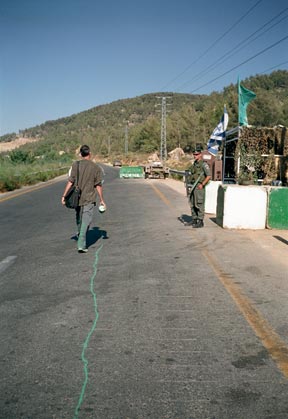
For personal reasons, the most interesting out of his projects was the film called Green Line. Breathtaking documentary where he tries to recrate The Green Line. The line, drawn in 47 (likely) that was supposed to divide Palestine into two independent countries. Alys takes a green paint, makes a hole in the can and walks along the original green line - he starts his joureny well before Jerusalem, corssing Old Town, Jewish Quater, Arabic Quater, East Jerusalem, Palestinian Villages, posh Israeli neighbourhoods, Jewish Orthodox District. His journey makes the viewer think about the complexity of borders - its power to create here and there, to divide, to mark us from the other - but also, in a strange way, a complicty, collaboration of the two sides. It becomes very clear that one side cannot exist without the other. What's the most amazing is that actually we see more than one film. In his trial to portray many different points of veiw, variety of simultaneous narratives that are emerging from recration of the green line - he recorded 12 different voice overs. Each of them marks a conversation that happened spontanously when he presented the film to different people - Jews and Palestinians, architects, campagner, fighters, people living there ... and elswhere. So we hear 12 stories commenting the same footage - different feelings, different angles, different ways of resolving the conflict .. and the same one hope.

If there is one single thing I could ever done in my life - this would be it. Absolutely stunning.

http://www.tate.org.uk/modern/exhibitions/francisalys/roomguide9.shtm